Tuesday, August 21, 2012

Nothopanax Delavayi

Nothopanax delavayi in bloom in my garden
     Another evergreen shrub or small tree in the great aralia family is Nothopanax delavayi.  This is a plant that Sean Hogan gave me a number of years ago in a small 4 inch pot and you can see from the picture that it has done quite well in my garden.  I should note that there does not seem to be agreement among the plant gurus I know as to the proper name for this shrub.  While Sean has told me again and again that it is indeed Nothopanax delavayi and that is what he says it is in his book  'Trees For All Seasons',  Dan Hinkley has told me that it is Metapanax delavayi and that is what he calls it in his book 'The Explorer's Garden- Shrubs and Vines'.  Well, whatever it is, it is a great shrub.
     As I said, it is in the aralia family so it is related to Scheffleras which I blogged about here; to Tetrapanax which I blogged about here; and to Sinopanax which I blogged about here.  There seem to be a lot of plants whose names end in panax and you can be sure that they will all be good plants.  In addition to the tetrapanaxes, sinopanaxes, and nothopanaxes, there are the metapanaxes, the dendropanaxes, the pseudopanaxes and the oplopanaxes.  Indeed, Oplopanax horridus is our own native panax which many a hiker in northwest woods knows as the Devil's Walking Stick.  I wouldn't be surprised if there are other panaxes that I am not familiar with.
     This Nothpanax which is growing in my garden has done very well and has never suffered from the cold in all the time I have grown it.  Sean says it is hardy to below 0 degrees F.  It looks good all year round.  In the winter, the leaves remain on it and stay green. In the spring the new growth has a reddish tint to it which is very attractive, and in late summer the flowers on it look good. When you walk by this shrub when it is in flower the sound of the bees buzzing as they gather its nectar is amazing.
     Nothopanax delavayi can be pruned much like you would prune a Fatsia, to which it is also related.  It can basically be cut down and growth will break from any branch.  It can be trained as a single trunked specimen or a multitrunked specimen as I have done.  It is growing in almost full sun in my garden, but it will also take shade, just like a Fatsia.
     If you wish to make this shrub more colorful, then I would suggest growing vines through it.  As you can see from the picture, I have tropaeolum speciosum growing in it.  Those are the red flowers you see in the right hand side of the picture.  I previously blogged about this vine here.  The red flowers you see in the lower left hand corner of the picture are those of Alstroemeria psittacina 'Variegata'.  The banana in the far right of the picture is a form of Musa sikkimensis which I will have a blog entry on in the future.

Monday, August 20, 2012

Nolina Nelsonii in Bloom!

Nolina nelsonii in bloom
     I have previously posted about Nolina nelsonii (here).  Well, just the other day I was out in my front border and lo and behold!, there was a bloom stalk starting up on one of my Nolina nelsoniis.  This is quite an occurrence because although I have been growing these for at least 15 years, this is the first time one has bloomed in my garden.  Earlier this year a big branch from one of the nearby Eucalyptus trees fell on top of this particular Nolina and perhaps it thought its end was near and that is what prompted it to send up this flower stalk!  In any event, none of my other 11 or 12 Nolina nelsoniis are showing any signs of blooming.

Saturday, August 18, 2012

Echinopsis

Echinopsis in flower in my garden

Overhead view of Echinopsis flower

View of entire Echinopsis plant and flower
     Last summer I bought a cactus plant from Bainbridge Gardens primarily because it had a lot of buds on it and was about to bloom.  I knew nothing about it.  It was grown by Monrovia and was labeled as Echinopsis oxygona.   It bloomed spectacularly last summer and now, as you can see from the pictures, it is blooming again.  This is the first bloom on it this summer, but it has a lot of buds on it, so hopefully there should be a lot more coming.  Based on my experience with this plant last summer, these blooms do not last much more than a day, so it is important to photograph them right away!
     I have read on the internet that this cactus is from Brazil,  Uruguay, and Argentina, and that it is fairly hardy, but I do not think it would be hardy here.  My speculation is that it would be too wet in the wintertime here for it to survive over the long run.  Anyway,  this plant is ideally suited as a pot plant and I can easily winter over cactus type plants in my sunroom because they can be kept dry over the winter.  I generally do not water my cactus plants in the winter while they are in my sunroom and they seem to do just fine.
     This is by far the most spectacular bloom I have had on any of my cactus and so I have decided that I need more of these.  Apparently Echinopsis generally have spectacular flowers and they come in many other colors. So I have been busy this morning bidding on various Echinopsis on eBay.
     I treat almost all of my cactus, agaves, puyas and other dryland plants which I grow in pots the same-- in the winter in my sunroom I do not water them.  In the summer, I do water them regularly and I do fertilize them regularly with Fox Farm.  I also pot them up to larger pots as needed.  I use a cactus mix for their potting soil to which I sometimes add more sand and grit.  The commercially available (retail) cactus mixes I do not think much of.  Specialty Soils which is a wholesaler near us which sells to most of the growers around here makes up an aloe mix which I think is very good for all these dryland plants and that is the best mix I know of.
    

Friday, August 17, 2012

Eucomis Pole-Evansii

Eucomis pole-evansii blooming in my garden
     There are so many great plants from South Africa and I have highlighted quite a few of them recently.  Eucomis, commonly known as pineapple lilies, are another such great plant.  One species of Eucomis that I particularly like is the one pictured here--Eucomis pole-evansii.  This is the largest of the pineapple lilies, making these large strap like leaves which can be in excess of three feet tall and then having the flowers rise above the leaves for one or two feet.  While you may have noticed that the flowers on this are greenish white,  I forgive this plant this one shortcoming because I like it so much.  Apparently there is a form of this Eucomis which has reddish or pinkish leaves and flowers called Eucomis pole-evansii purpurea (see here), but I have not yet acquired that form of it.  Of course it is on my must have list.
     I first learned about this Eucomis many years ago from Myles Challis' book on Exotic Gardening which I have previously described.  At the time I read about it in his book this plant was not available here.  When I was at Heronswood one day and found that they had some I was very excited and bought quite a few.  At that time it was thought that these bulbs were perhaps tender here, but we have since found out that they are perfectly hardy.  I still have some of those Eucomis that I bought from Heronswood when they first offered them, at least 15 years ago.  By now those bulbs are huge.
     I have grown this Eucomis from seed that I got from Silverhill Seeds and they proved very easy to grow.  Eucomis bulk up quite quickly if they are well watered and fed, so growing them from seed is not such a long term prospect as some other plants grown from seed.  Eucomis can also be propagated from leaf cuttings and that is the way to get more of select cultivars.  Eucomis pole-evansii is now offered by quite a few nurseries which a google search will reveal.
     I have grown this Eucomis in many parts of my garden and I conclude that all Eucomis, including this one are better is full sun because the foliage stands up instead of flopping around if they are in full sun.  They will tolerate some shade, however.  I remember seeing a slide show of Dan Hinkley's once where he showed Eucomis growing wild in South Africa and they were growing out in the open with no tall foliage around to shade them, so that gives you an idea of what conditions they like.
     I grow a number of Eucomis in my front border which is in full sun, is never watered, and which is visited by deer on a daily basis.  They do quite well in those conditions.  I have never had deer eat any of my Eucomis.  Slugs like them, however, so if you grow them where slugs are a problem be sure to bait for them.


Thursday, August 16, 2012

Boophane Disticha

Boophane disticha in a pot in my garden
     Every once in a while a plant comes to my attention that catches my fancy and I must have it.  Boophane disticha, a bulb native to South Africa and other parts of Africa is the most recent plant for me to obsess over.  According to Wikipedia this bulb resembles both Haemanthus and Brunsvigia but it has been placed in a genus by itself.  There are 5 or 6  species in the genus according to the PlantzAfrica website.  The bulb is poisonous and the poisons have been used for medicine and to make the tips of arrows poisonous.  The name Boophane derives from Greek words which mean ox death, referring to the poisonous nature of the bulbs.  The second part of the name, disticha,  means leaves erect in a fan shape.  Good pictures of this bulb can also be found at Bihrmann's Caudiciform website.
     This bulb, which becomes quite large and which sits on top of the ground, also has very attractive blue green leaves which form this very nice fan over time.  It was this appearance of the bulb which first caught my attention--it looks very attractive even when not in bloom.  The bloom, however, also appears to be quite striking, being a large red allium like ball.
     I have known about this bulb for a few years, but last year I purchased Haemanthus albiflos from Cistus Nursery and it wintered over in my sunroom very successfully.  This bulb which has somewhat similar requirements to Boophane, gave me the idea that I could successfully grow Boophane in a pot and winter it in my sunroom.  According to what I have read on the internet, some Boophanes are from summer rain areas of South Africa and some are from winter rain areas.  The significance of this is that if you get a bulb from a summer rain area, you can grow it by keeping it outside in the summer and watering it then, so that it grows then, while in the winter you can keep it fairly dry in a sunroom. It is more difficult to winter over a winter growing bulb here.
     So after deciding I must have some Boophanes, I just had to find a source.  The first source I found was Telos Rare Bulbs which had small plants of both Boophane disticha and Boophane haemthoides (which, by the way, looks pretty good too).  So I ordered three of each and recieved them in good condition and they are growing well.  However, these were very small plants and would take a number of years to get to the size I want.
     So I found 2 other sources--Arid Lands Greenhouses and Out of Africa and I ordered plants from both.  The ones from Arid Lands were also small seedlings like the ones from Telos, but I got the one you see in the picture above from Out of Africa.  At the same time I was doing this searching I also noticed that Paul Christian Bulbs offered what looks like a large bulb of Boophane, but it is very expensive.  I might have to order it nonetheless.  Finally, I notice that San Marcos Growers, the big wholesale nursery near San Diego, has Boohane disticha in 3/5 gal. containers listed on the current availability list.  Oh, to be in San Diego!
     As for caring for these bulbs, if they are summer growers and I am going to assume all of mine are, I am growing them in fairly deep containers (they have extensive root systems from what I have read and like to be in deep pots) and watering and fertilizing them well in the summer.  In winter I will take them into my sunroom and keep them fairly dry.
    

Wednesday, August 15, 2012

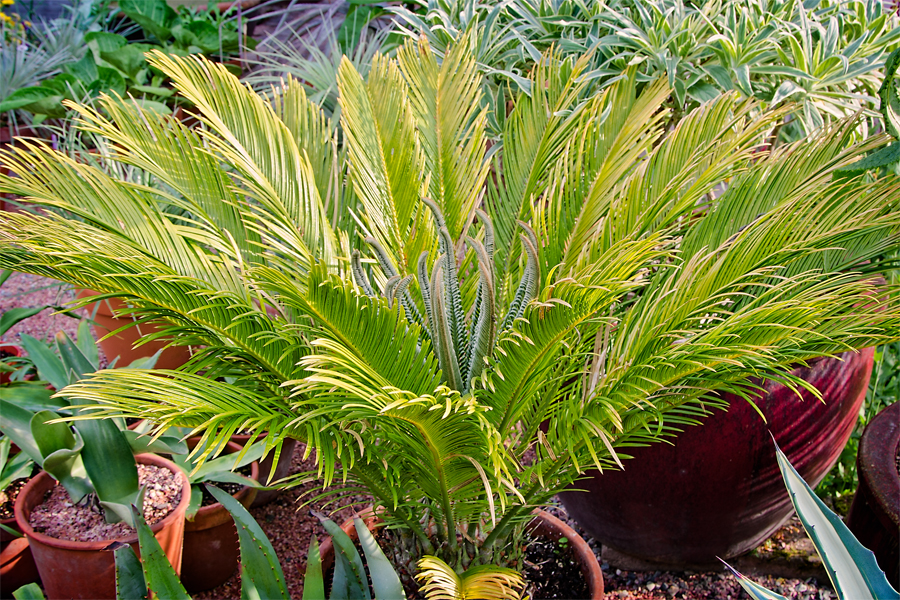
Cycas Revoluta

New growth on Cycas revoluta

Full view of Cycas revoluta
     I have mentioned in my post on Cypriprediums that they could be expensive annuals.  Well, in my gardening career the most expensive annuals I have grown have been cycads.  For those who don't know, cycads are a group of plants very primitive in origin which many uninformed people confuse with palms.  They are not palms, however, but are in their own grouping of plants.  There are over 200 different kinds of cycads, many of which are endangered species.  The most commonly grown cycad is the one pictured above--Cycas revoluta, also commonly known as Sago Palm (although it is not a palm).  Cycas revoluta, being so commonly grown. is not endangered.
     Many years ago when I first discovered cycads I became enamored of them and spent a lot of time and money trying to figure out if there were any that would be hardy in our climate.  The message boards concerning growing exotic plants in temperate climates were filled with discussion of which cycads might be hardy and how to find them.  I have spent what seems like a fortune in the quest to find a hardy cycad and I can now report to you that there are none that are hardy in our climate.  The dead cycads I have grown will attest to this fact.
     Although some nurseries in southern states, located in zone 8 just like us, say that some cycads are hardy for them, the difference in summer heat between those states and Bainbridge Island is what dooms cycads here.  There simply is not enough heat here for them to grow well if they are left outside year round.  To illustrate this difference in summer heat, in the recent heat spell which has gripped much of the country, our high temperature has been in perhaps the high 80s (Fahrenheit) and that only lasted for a day or two while other parts of the country have seen temperatures well above 100 for days on end.  Even Portland and the Willamette Valley only a few hours south of us have much more summer heat than we do.
     As of last year, after killing countless cycads, I was cycadless and so when I saw a fairly full and well grown Sago Palm at Bainbridge Gardens for a reasonable price, I bought it.  Several months ago I noticed that it was starting a new growth flush.  This was exciting, because even though I have grown many cycads in the past, they have rarely done well enough to put out new growth.  I believe cycads require heat and sun to put out new growth in our climate.  Of all the plants that I have grown cycads have most puzzled me about what they require to grow well since I have never succeeded in getting them to grow well.  So when I read somewhere on the internet that the Sago Palm appreciates lots of water and fertilizer when it is putting out new growth I seized on that tidbit and have been making sure it is well watered and have been generous with the Fox Farm fertilizer.  So far so good as you can see from the pictures.
    

Tuesday, August 14, 2012

Zandtedeschia

Zantedeschia flower of unnamed plant

Looking down on the same flower
     Several years ago I got a Zantedeschia which had been grown from seed by my friend Terry Stanley.  She is a garden designer who used to live on Bainbridge Island, and now lives in Kingston, on the Kitsap Penninsula.  At the time I got the plant from her, she owned a nursery called Mesogeo, which specialized in Mediterranean plants and she grew many great and unusual plants from seed.
     This Zantedeschia, also known as calla lily, grew and bloomed well for a couple of years in a fairly damp, partly shaded spot in my garden right over the septic drainfield.  However, for the last couple of years, although it put out a great deal of foliage, which, by the way is spotted, it did not flower.  So this spring I dug up all the bulbs and found that it had greatly multiplied.  I got at least 50 bulbs from that one plant.  I replanted these bulbs, which had been very congested in their old location, into various places in the garden and all but the smallest of those bulbs are blooming now.
     When the flowers on this plant first open, they are a pale yellow, almost white.   If you look down into the flower you will see a dark throat in the center.  As the flower matures, the yellow gets deeper in color, eventually turning sort of mango colored.  As you can see, it is a very beautiful flower.
     In my gardening career I have grown a number of different calla lilies, including some of the white ones like the one called 'Crowborough'.  I have to say, that since it had white flowers and since it was eaten by the slugs I got rid of that plant.  I also once grew a lot of almost black flowered callas when dark flowers were in fashion.  I am not enamored of so called black flowers either, since they are hard to see in the garden and they are not colorful.  I like color, as I think I have said on more than one occasion, so out with the black flowers, too!  I do, however, love the orange flowered callas in particular, and I would not object to yellow or pink flowered ones either.
     Based on my experience growing these, they seem to do best in full sun in our climate in fairly damp soil.  The bulbs can rot, however, if the soil is not well drained enough.  They also seem to require dividing every few years, since if they get too congested they will not bloom well.  The plants I have in the garden now do not seem to be bothered much by slugs, but I use Sluggo regularly in the garden and that has cut down on the slug problems I used to have.